Homeowners love an established garden… right up until they’ve spent three months dragging hoses around it.
Last month our Blenheim team wrapped a landscape irrigation job for customers who’d just moved into a new place with an immaculate, fully established landscape. They wanted something far less labour-intensive than hand watering, but the brief came with a major twist:
“Don’t dig the lawn up.”
No trenching across the main viewing lines. No pop-ups through the turf. No new mainline and cable runs carved across pristine grass.
So we went a different way.
What’s the best way to automate watering when you can’t trench your lawn?
If you can’t dig up an established lawn, the simplest approach is usually to build the system off existing outdoor taps using battery-operated Bluetooth controllers and valves, then distribute water via low-visibility sprinklers tucked into garden beds. You get reliable, scheduled watering (including at night), keep disruption minimal, and avoid the “freshly trenched” look that can take months to disappear.
The problem: great landscaping, zero appetite for mess.
This property had two things going on:
- A lot of established planting that needed consistent summer watering.
- A lawn that was basically sacred. Trenching lines through it was off the table.
Even a tidy reinstatement can leave visible scars for a long time, especially in a highly maintained landscape where you’re looking down from the house.
The customers weren’t asking for “the perfect irrigation system on paper”. They were asking for a practical system that didn’t wreck the look of the place.
The “no-dig design” approach we used.
When trenching is limited, you design around what you can use already. In this case, the key was using existing taps as the supply points and building a tidy, discreet watering layout from there.
1) Battery-operated Bluetooth controllers and valves off existing taps
We supplied battery-operated controllers and valves fed from the customer’s existing taps. Why Bluetooth? Because it makes day-to-day use genuinely easier:
- Simple programming on your phone
- Quick adjustments when seasons change
- Easy “manual run” when you want to test a zone or give an area a top-up
- No hunting around for a controller box inside the garage
This is the kind of setup that suits homeowners who want it to “just work” without learning a whole new control system.
2) Hunter PGP sprinklers on low stakes in the garden beds
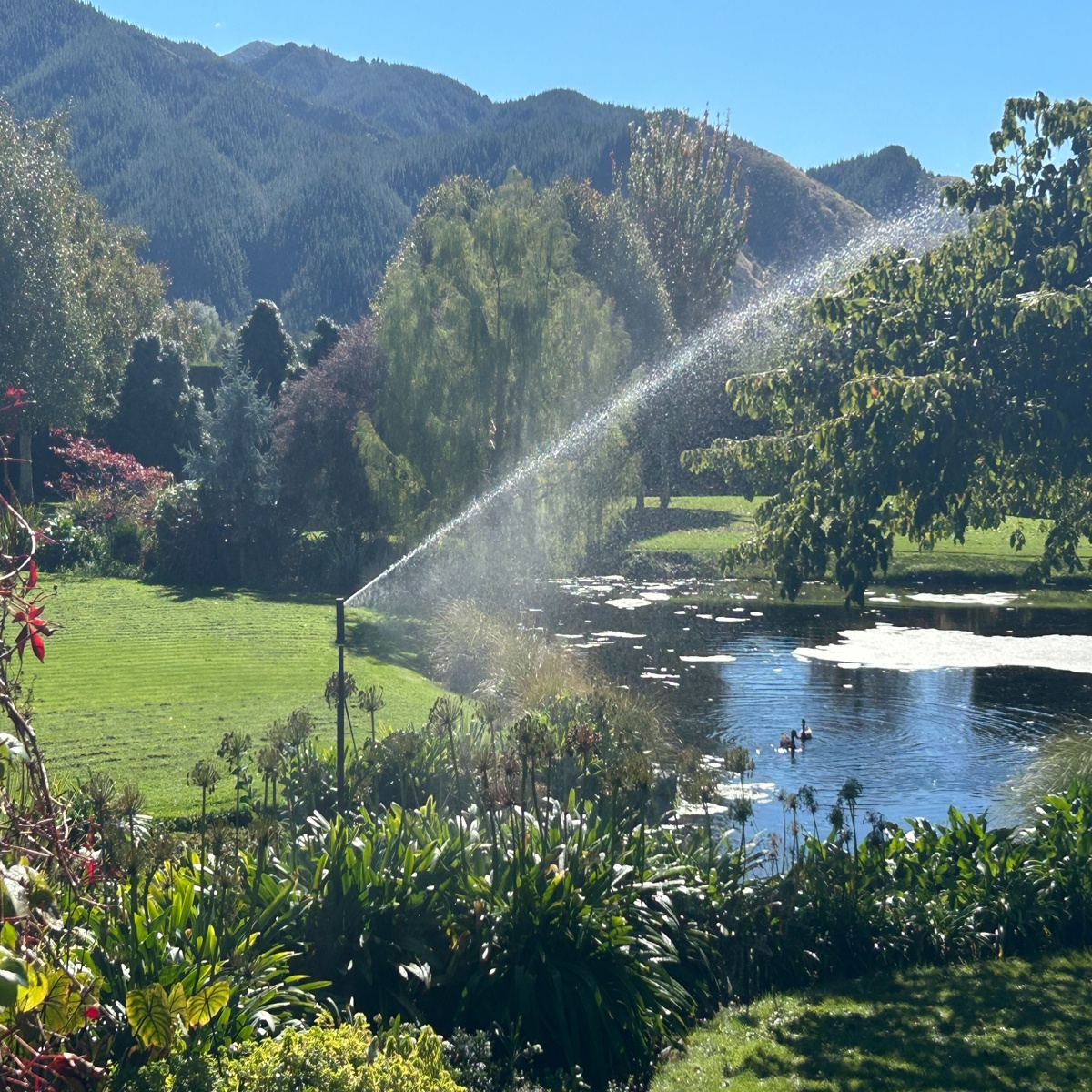
Instead of pop-up sprinklers in turf, we used Hunter PGP sprinklers mounted on low-level stakes placed through the surrounding gardens. We also used a handful of taller stakes where we needed a bit more reach for coverage.
The aim here was straightforward:
- Put the water where it’s needed
- Keep the hardware subtle
- Avoid anything that screams “irrigation system” from the living room window
3) Keep sprinklers low and tucked behind planting
This is the part that makes the difference on established landscapes. By keeping sprinklers down low and tucked in behind plants, you:
- reduce visual impact
- protect sprinklers from mowers and foot traffic
- still get decent coverage across garden edges and planting areas
It’s a simple design principle, but it’s one we lean on a lot when the landscaping is already dialled in.
4) Only trench where the ground was already disturbed
This job required smart digging. The only trenching we needed was along the top of a new drainage trench, where the ground was already disturbed. That meant:
- no fresh scars across the “show” areas
- no cutting through established root zones unnecessarily
- easier reinstatement (because the area was already being worked)
First run results: customers are rapt
We fired the system up for the first time and the customers were stoked.
The big wins they noticed:
- No more dragging hoses around all summer
- Everything stays green easily
- Night irrigation is now on the table, which is usually more efficient (less wind, less evaporation)
- Minimal aesthetic impact, which was the whole point of the brief
This is the sort of job where success isn’t just measured in coverage. It’s measured in whether the customer feels like they’ve kept the character of the property while gaining the convenience of automation.
Key takeaways if you’ve got an established landscape and hate the idea of trenching, or if you’re considering irrigation but don’t want your lawn cut up, here are the practical lessons from this install:
- Start with your constraints. If trenching is limited, plan around existing water points.
- Battery and Bluetooth can be a great fit for tidy retrofits where running cable isn’t worth it.
- Stake-mounted sprinklers in garden beds can deliver solid coverage without touching turf.
- Placement matters more than people think. Low and hidden can still water well.
- Trench only where it won’t show (or where ground is already being disturbed).
If you’re unsure what’s possible on your site, photos and a quick walkthrough usually tell us a lot. Especially when the brief includes “don’t touch the lawn”.
What’s next at this site, next stage we’re taking the same no-dig design approach out to the main lawn and garden area with a solid-set system off the vineyard mainline.
Want a low-disruption irrigation setup for your property?
If you’re in Marlborough (or anywhere we cover) and you’re sick of hoses, but you don’t want your place looking like a trenching project, we can help.
Get in touch with WaterForce and tell us two things:
- what areas you want watered, and
- what you absolutely don’t want disturbed.
We’ll work out an option that fits the site, the water supply, and the way you actually use the property.
Contact your local WaterForce branch (or our Blenheim team) to book a site visit and talk through a no-dig irrigation option.