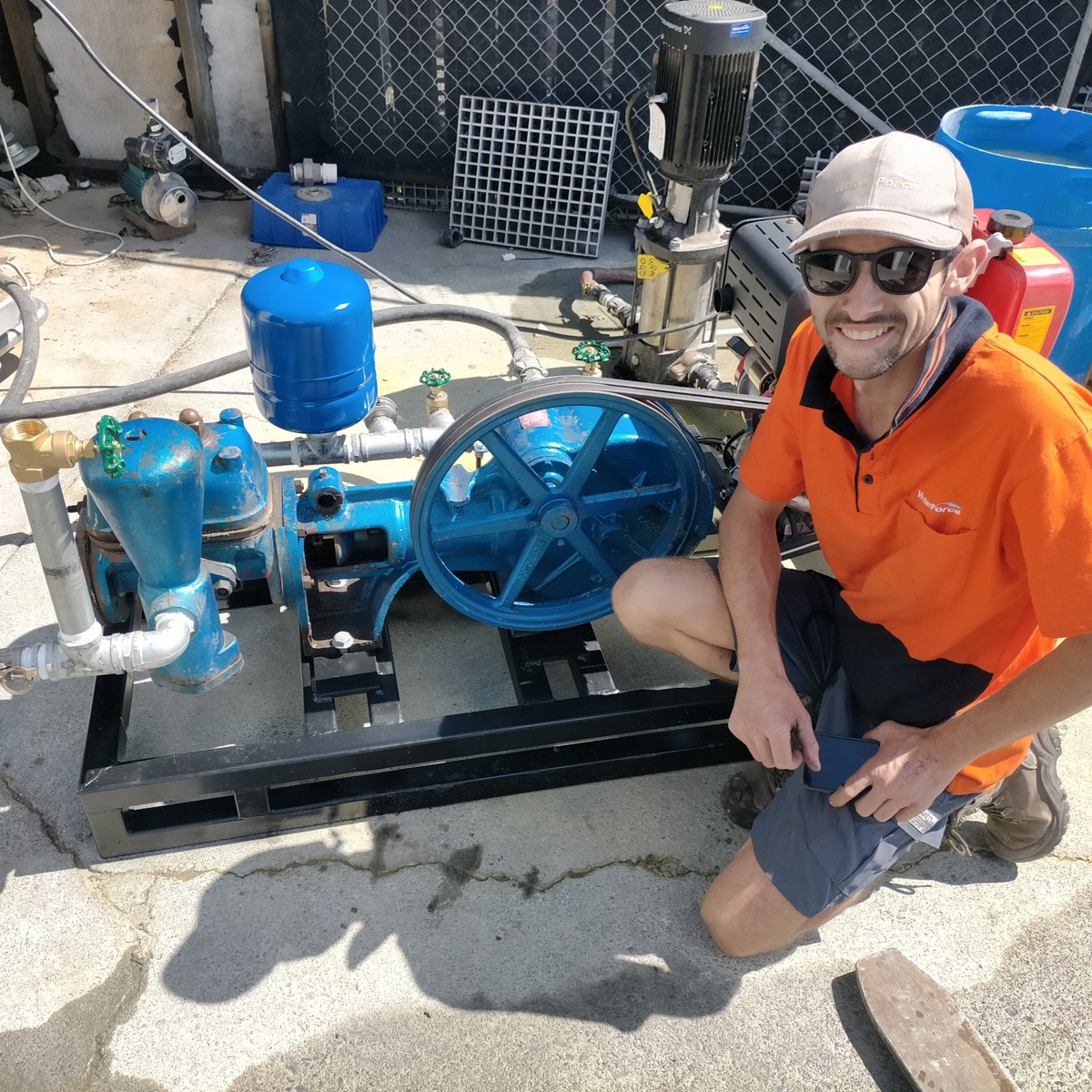
Bulldozer pumps (also called piston pumps) are still a key player in rural water supplies across New Zealand. If you’ve got one pulling from a dam or spring and pushing up to tanks on a hill, chances are it’s there for a reason. These pumps are tough, simple, and when they’re maintained properly, they’ll run for years.
At WaterForce we’re still working on these pumps regularly, especially in regions where they’ve been part of the farming backbone for decades. In Hawke’s Bay, our team is maintaining bulldozer pumps in the field every season, keeping farm and rural water supplies running when they can’t afford downtime.
Why are bulldozer pumps still a good option on farm water?
NZ-made bulldozer (piston) pumps are still a great fit for farm water when you need suction lift from a dam or spring and reliable pressure to push water uphill to tanks and long lines. Because they’re positive displacement, output is closely tied to pump speed, which makes them predictable in real-world rural setups.
What makes a piston pump different on rural water jobs?
Most farm water discussions end up comparing piston pumps with centrifugal pumps. The practical difference is pretty simple.
- Piston pumps are positive displacement, so each stroke moves a set amount of water.
- Their output is closely related to pump speed, which makes them consistent and predictable.
- They’re often chosen for suction lift plus higher pressure delivery, like lifting from a dam and pushing to header tanks on a hill.
- They’re mechanically serviceable, which matters when the pump is 30 minutes from town and it’s feeding everything.
If the pump is set up right and looked after, it’ll do a lot of work without fuss.
Where these pumps still shine (and why we still see them)
These are the situations where bulldozer pumps keep proving themselves:
- Suction lift jobs where staying primed matters
- High head delivery, like pushing up to hill tanks or higher-pressure zones
- Long farm lines feeding troughs, shed supply, or lifestyle block reticulation
- Existing systems where changing pump type would mean reworking the whole setup
They’re also a good match for people who want a pump that can be maintained properly, not treated as a throwaway unit.
The pump brands we’re still maintaining at WaterForce
The common NZ-made units we see (and work on) include:
- Anderson
- MacEwans H Series
- Renown / WH Price
- Track B1 and C1
- Wallace / Powerflo
If you’re running one of these, the biggest risk usually isn’t age. It’s maintenance being skipped until it fails, usually right when water demand is highest.
WaterForce’s approach: keep your water supply running while we service the pump
A lot of farm water systems don’t have much redundancy. When that pump stops, everything stops.
That’s why we treat bulldozer pump maintenance like a water continuity job, not just a repair:
- Field checks and servicing where practical
- Field rebuilds when components need a proper strip-down (many of these pumps are too heavy and awkward to shift, and the job is often better done on site)
- Parts supply for common wear items
- Swap-over pump options (where available) so you can keep water on while servicing is completed
In Hawke’s Bay, we’re doing this work every year. It’s not unusual for a customer to say: “We can’t afford to have the tanks empty for a week.” Fair call. We plan around that.
One of the key people on these piston pump maintenance jobs in Hawke’s Bay is Matthew Chambers, who’s got 10+ years of industry experience. He knows the common failures, the quick fixes that don’t last, and what actually holds up on farm. The focus is always the same: keep the pump dependable and keep the water on.
What actually goes wrong with bulldozer pumps (the stuff we fix all the time)
Most issues fall into a few repeat categories.
Air leaks and loss of prime
If the pump is struggling to lift or won’t stay primed, it’s often not the pump body. It’s usually:
- tired suction hose
- loose clamps or fittings
- worn gland packing letting air in
- small cracks or pinholes that only show up under suction
We’ll check the suction line, fittings, and sealing points properly, because you can lose a lot of performance from one tiny air leak.
Worn cups, valves, and rubbers
These pumps work because the wet-end seals are doing their job. Over time, those wear parts give up. Symptoms can be:
- pump runs but delivers poorly
- reduced pressure
- uneven delivery or cycling
This is where a proper inspection matters. Replacing the right wear parts at the right time is what gets performance back, not just tightening everything and hoping.
Back-end wear from oil issues
The backend is full of moving metal parts. Oil isn’t optional maintenance, it’s the difference between a pump that lasts and one that eats itself. Common warning signs:
- oil dark and gritty (wear particles)
- grey or foamy oil (water contamination)
- knocking or increased mechanical noise
If you catch it early, it’s usually manageable. Leave it too long and it gets expensive fast.
A winter maintenance checklist that prevents summer call-outs
Winter is the time to get ahead. Here’s what we recommend, and what we work through during a WaterForce service.
1) Check and change the back-end oil
You’re protecting gears, eccentric, connecting rod, and crosshead.
- Clear, golden oil is what you want
- Dark and gritty means drain and replace
- Grey or foamy suggests water contamination and should be dealt with quickly
Oil grade can vary by pump model, so we match oil to the unit rather than guessing.
2) Check tightness and wear before it becomes damage
As pumps age, clearances open up and wear creeps in.
A simple tell is turning the pulley and feeling how quickly the pump responds. Excess delay or persistent knocking under light loads can signal internal wear that needs attention before it escalates.
3) Inspect gland packing (especially on suction lift jobs)
Gland packing does two jobs: it stops leaks and it prevents air being drawn back in.
- a few drips can be normal
- squirting or flowing isn’t
- tightening the gland nut is the first step
- if it still leaks, replace the packing and check follower/rod condition
If your pump is losing prime, we nearly always look here early. It’s a small part that causes big headaches when it’s tired.
Repair vs replace: when each one makes sense
We’ll usually recommend a repair when:
- the pump body and core components are sound
- it’s the usual wear parts causing issues
- the system still suits suction lift and high head delivery
- you want confidence it’ll run reliably through peak demand
Replacement can make more sense when:
- there’s repeated back-end failure or major wear
- the farm’s water needs have changed (more flow, different pressure zones)
- you’re redesigning the whole scheme anyway
Either way, the call should be based on actual condition and performance, not guesswork.
Need yours checked before it becomes a drama?
If you’ve got a bulldozer (piston) pump that’s critical to stock water or rural supply, WaterForce can help with:
- servicing and rebuilds in the field
- parts for common NZ-made pumps
- on-farm troubleshooting
- swap-over pump options (where available) to keep supply running during maintenance
Get in touch with your local WaterForce branch and tell us:
- pump make/model (if known)
- where it’s lifting from (dam, spring, etc.)
- what it feeds (tanks, troughs, house, shed)
- any symptoms (losing prime, low pressure, leaks)
We’ll take it from there.