Wall gardens are a smart way to grow fresh vegetables, herbs and salad greens at home, especially when outdoor space is limited. Positioned near the kitchen, they make it easy to step outside and pick what you need while preparing dinner.
There is one catch. Pots and small growing containers can dry out fast.
A reliable wall garden irrigation system takes care of the regular watering, helping plants stay healthy when you’re busy, at work or away for a few days.
What is the best way to water a wall garden?
The best option is an automatic drip or micro-irrigation system controlled by a Wi-Fi irrigation controller. The controller runs the system on a programmed schedule, while filters, pressure control and correctly selected emitters deliver a steady amount of water to each pot.
Once it’s set up properly, you won’t need to walk around with a hose every morning. The system quietly gets on with the job.
Why wall gardens need regular watering
Vegetables grown in wall-mounted pots have a smaller volume of soil available around their roots than vegetables planted in a garden bed.
That smaller soil volume can lose moisture quickly, particularly when:
- The wall receives strong afternoon sun
- Pots are exposed to wind
- Plants are actively growing or producing vegetables
- Containers are small or shallow
- The weather turns hot for several days
- The growing mix drains freely
Missing one watering cycle on a cool day might not matter. Missing it during a hot, dry spell can leave leafy greens wilted and young vegetable plants under real stress.
Automating the job removes much of that risk.
Use a Wi-Fi controller to automate watering
For this type of home irrigation system, we often recommend a Hunter controller using Hydrawise software.
Hydrawise lets you manage irrigation from a smart phone or web browser. Depending on the controller and system setup, you can start, stop, suspend or adjust watering without needing to stand beside the controller.
Its weather-based features can also use local conditions and forecasts to adjust irrigation. Watering can be reduced during cool or wet weather and increased when conditions are hot and dry, rather than applying exactly the same amount every day of the year.
That makes a real difference in a wall garden. A pot of lettuce doesn’t need the same watering in October as it does during a hot January afternoon.
You can learn more about the available Hydrawise controllers and hardware or explore the wider Hydrawise irrigation platform.
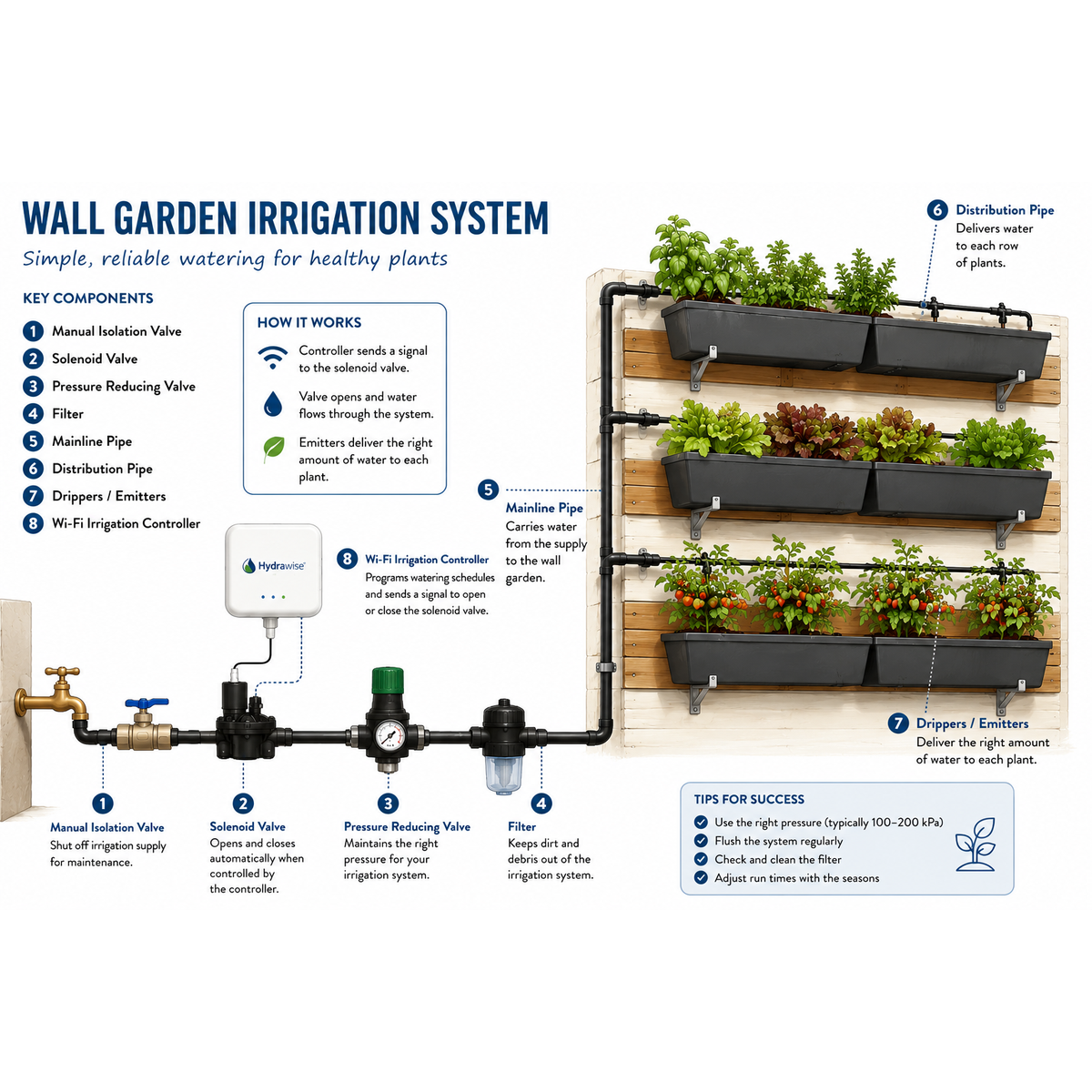
The main components of a wall garden irrigation system
A good system is more than a controller connected to a length of pipe. Each component has a job to do, and getting them matched correctly is what makes the finished setup dependable.
Wi-Fi irrigation controller
The controller is the brain of the system. It determines when irrigation starts, how long it runs and which watering zones operate.
Choose a model with enough stations for your current layout, plus some spare capacity if you’re planning to add more pots, planter boxes or garden areas later.
Manual isolation valve
A manual isolation valve allows you to shut off the irrigation supply without turning off water to the entire house.
This is useful when servicing the filter, replacing an emitter or making changes to the pipework.
Install the valve somewhere accessible. Hiding it behind a fixed planter may look tidy on day one, but it won’t be much fun when maintenance is needed.
Solenoid valve
The solenoid valve opens and closes automatically when instructed by the controller.
It needs to suit:
- The available water pressure
- The system’s flow rate
- The pipe size
- The controller’s electrical requirements
- Its installation location
Using a quality valve matters. This is one of the hardest-working components in an automatic irrigation system.
Pressure-reducing valve
Household water pressure is often higher than small irrigation pipe and drippers need.
A pressure-reducing valve keeps the downstream pressure within the correct operating range. Without one, fittings may leak or come apart, and emitters may apply more water than the system was designed to deliver.
Correct pressure also helps the emitters provide more consistent watering from the first pot to the last.
Irrigation filter
Drip emitters contain small water passages, so fine debris can cause blockages.
A suitable filter helps keep sediment and other particles out of the irrigation lines. This is particularly important for homes using tank or bore water, but filtration is still good practice on other supplies.
The filter should also be easy to reach and clean.
Pipe, fittings and brackets
The pipe carries water from the valve assembly to the wall garden. Fittings create branches and connections, while brackets hold thepipe firmly in place.
Plan the route before starting. A neat, supported pipe run looks better, is less likely to be damaged and makes future servicing easier.
Consider:
- How the main pipe will reach the wall
- Where it can be hidden without becoming inaccessible
- How each level of pots will be supplied
- Whether pipes are exposed to sun or frost
- Where lines can be flushed
- How the system can be expanded later
Drippers or micro-irrigation emitters
The emitters control how much water reaches each pot.
Emitter selection should be based on the size of the container, the type of plant and the system’s total available flow. A small herb pot may need a different arrangement from a deep planter growing tomatoes.
Large or long containers may need more than one emitter so water is distributed through the growing mix rather than concentrated in one wet spot.
Pressure-compensating emitters can be useful where pots are installed at different heights, although the complete system still needs to be designed around the available pressure and flow.
How often should a wall garden be watered?
There isn’t one schedule that works for every wall garden.
Watering frequency depends on the plant, container size, growing mix, sun exposure, wind and time of year. In warm weather, small vegetable pots may require frequent watering. During cooler or wetter conditions, they’ll need less.
Start by checking the growing mix after each irrigation cycle. It should be moist through the root zone, not just wet on the surface.
It’s often better to use a controlled watering cycle that soaks the pot properly than a very short run that only dampens the top few centimetres. Watch for drainage from the bottom of the containers, then adjust the run time and emitter flow to avoid wasting water.
Hydrawise can make seasonal management easier by changing watering in response to local weather information, but the initial system still needs to be programmed and tested properly.
Is a wall garden irrigation system suitable for DIY installation?
For many homeowners, yes. It can be a satisfying DIY project, particularly when the water connection and electrical supply are already available.
The straight forward work often includes:
- Mounting and supporting irrigation pipe
- Running small distribution tube to each pot
- Installing emitters
- Labelling lines
- Testing the watering pattern
- Adjusting controller programmes
The trickier parts can include selecting the correct valve and pressure equipment, checking available flow, wiring the controller and solenoid, and connecting safely to the water supply.
Controllers must be installed in a suitable location with dependable Wi-Fi coverage and in accordance with the manufacturer’s instructions. Electrical or plumbing work that requires a licensed trade professional shouldn’t be treated as a DIY shortcut.
WaterForce can help with the complete installation, or take care of the technical sections and leave you with the simpler pipe and emitter work.
Common mistakes to avoid
A wall garden system is small, but the same basic irrigation principles still apply.
Watch out for these common problems:
- Skipping the filter: Small emitters can block easily.
- Ignoring water pressure: Excess pressure can create leaks and uneven application.
- Using the same emitter for every pot: Different plants and containers may have different water requirements.
- Making maintenance difficult: Filters, valves and flush points need to remain accessible.
- Setting one programme for the entire year: Seasonal conditions change.
- Failing to test every pot: Check the last and highest outlets, not just the emitter closest to the tap.
- Adding too many emitters: The water supply must be able to operate them together at the required pressure.
- Relying on automation without checking the garden: Controllers help, but blocked emitters and damaged pipes still need to be spotted.
Run the finished system while you’re home for several days. Check each pot, look for leaks and confirm the root zone is receiving enough water before relying on it while you’re away.
Get the right wall garden irrigation setup
A properly designed automatic watering system lets you enjoy your wall garden without organising your day around a hose.
At WaterForce, our home irrigation specialists can help you select a compatible controller, solenoid valve, pressure reducer, filter, pipework and emitters. We can also install the full system, handle the technical parts of the job, or provide practical advice for a DIY setup.
Explore our home irrigation solutions, or contact your local WaterForce team to discuss your wall garden.
With the right equipment in place, you can head away for a few days knowing your vegetables and herbs are still getting the water they need.