A centre pivot is a major investment, but simply having the machine running does not mean you are getting the best irrigation outcome from it.
Good pivot irrigation is about getting the right amount of water, applied uniformly, at a rate the soil can absorb, when the crop needs it. Achieving that requires the mechanical machine, hydraulic design, sprinklerpackage and operating strategy to work together.
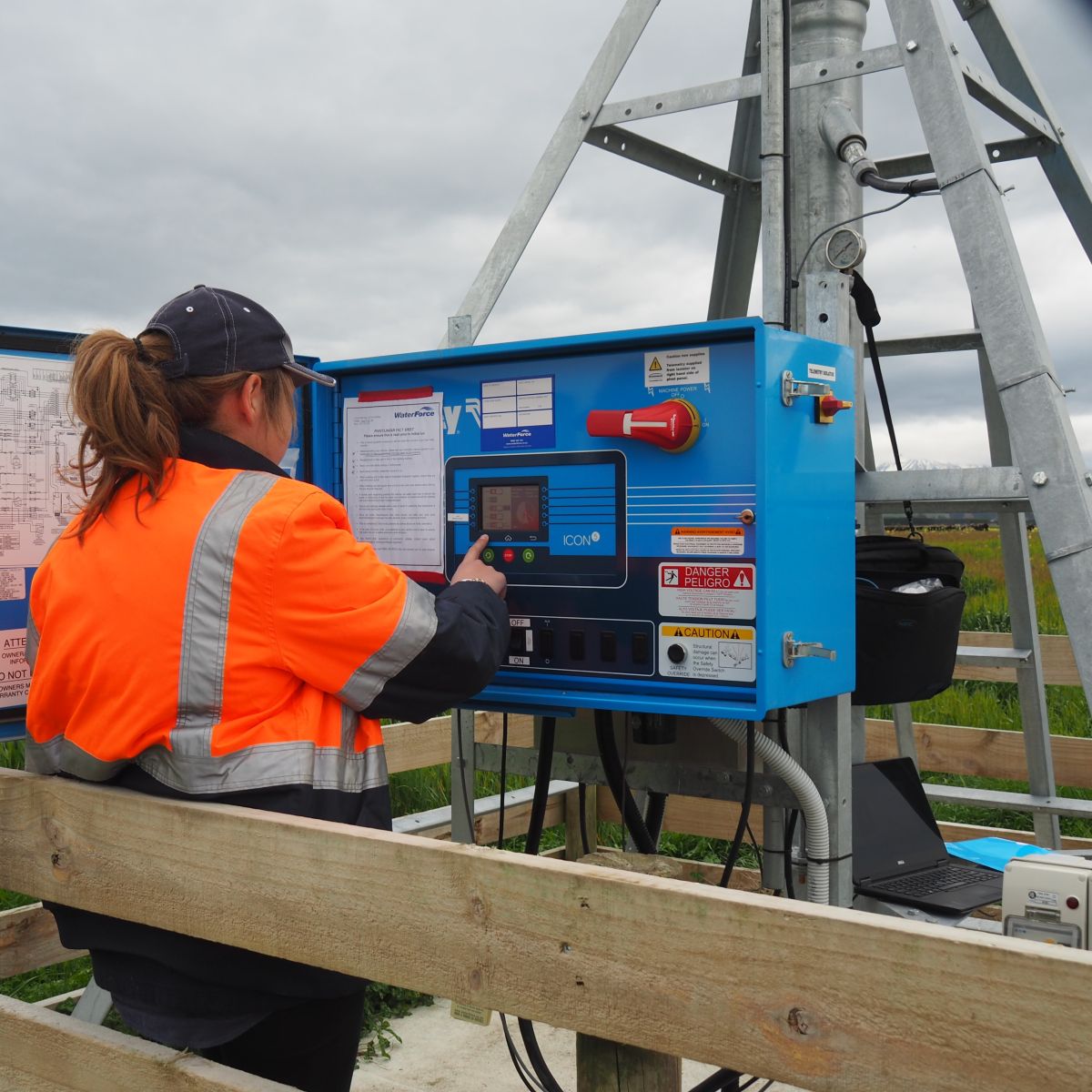
Technology such as Valley ICON control panels, AgSense365, GPSposition, pressure monitoring and machine diagnostics can make this much easier. But technology is most valuable when it is used to measure and verify what the irrigation system is actually doing, rather than simply providing remote start and stop.
Here are some of the key areas to consider if you want to get the most from your centre pivot.
Know how much water you are actually applying
Pivot speed is one of the main controls over irrigation depth.
· Slower rotation = more water applied per pass.
· Faster rotation = less water applied per pass.
· Changing pivot speed changes the time an area is watered andtherefore the total depth applied.
· It does not directly change the instantaneous application rate ofthe sprinkler package.
The soil underneath a sprinkler does not know what percentage is showing on the pivot panel. It sees water arriving at a particular intensity while the sprinkler passes over it. The total depth it receives depends on how long that application continues.
Modern control systems such as Valley ICON and AgSense365 make changing application settings and monitoring machine operation relatively simple. Use that capability to verify actual operation rather than assuming a percentage setting automatically equals a particular irrigation depth.
Actual revolution times and applied depths should be checked periodically.
Understand that bigger pivots have a bigger application-rate challenge
Pivot irrigation becomes increasingly demanding toward the outerend of the machine.
Consider two full-circle pivots, both designed to supply anaverage of 5 mm/day:
· Pivot A is 400m long.
· Pivot B is 700m long.
To apply a 10mm pass, both machines require approximately two days, or 48 hours, per revolution based on that average daily system capacity.
The 400m pivot travels approximately 2.51km around its outer circumference, requiring an average outer-end travel speed of about 52m/h. The 700m pivot travels approximately 4.40km, requiring about 92m/h.
More importantly, the outer portion of the 700m pivot represents a much larger area. The sprinkler package therefore has to deliver considerably more water toward the outer end while the machine continues moving.
That is why wetted foot print, sprinkler type, nozzle selection, pressure and soil infiltration become increasingly important as pivots get longer.
Match the sprinkler to the soil
Getting 10mm out of the sprinkler package does not necessarily mean the soil has effectively captured 10mm.
The important relationship is between sprinkler application rate and soil infiltration rate. When water is being applied faster than the soil can absorb it, water begins accumulating on the surface. If surface storage is exceeded, run-off can occur.
Soil infiltration is influenced by more than simply whether a soil is described as sandy, silty or clay-based. Soil structure, compaction, organic matter and other factors can significantly affect infiltration.
The sprinkler package therefore needs to suit the actual paddock. Consider:
· soil type and infiltration characteristics;
· slope and surface storage;
· required irrigation depth;
· pivot length and system capacity;
· available operating pressure;
· sprinkler wetted diameter;
· droplet size and energy;
· wind exposure; and
· crop and ground conditions.
Sprinkler selection should not simply be based on what was installed on the machine previously.
Consider sprinkler height and wind
Wind is another important part of sprinkler selection. Lower sprinkler mounting can reduce the amount of time droplets spend travelling through the air, helping reduce exposure to wind drift. But lower is not automatically better.
The installation also needs to consider:
· crop height;
· fences and other obstructions;
· wheel tracks and ground undulations;
· terrain;
· sprinkler pattern; and
· the risk of sprinklers contacting crops or objects.
Droplet selection is also a compromise. Smaller droplets can reduce soil impact and may suit some heavier soils, but they are generally more susceptible to wind. Larger droplets can provide greater wind resistance but can have greater energy when they hit the soil surface.
The objective is therefore not simply low pressure, low height or big droplets. It is finding the combination that best suits the paddock and operating conditions.
Remember that the pivot is really the delivery pipeline
The pivot structure gets plenty of attention because it is the biggest and most visible part of the system. But hydraulically, its main job is to transport water around the paddock.
At the point of application:
· the nozzle controls flow;
· the sprinkler controls the distribution pattern, wetted footprint and droplet characteristics; and
· the pressure regulator helps provide the pressure conditions required for that nozzle and sprinkler to operate correctly.
A structurally excellent pivot with a worn, incorrect or poorly operating sprinkler package can still produce a poor irrigation result. That is why sprinklers, nozzles and regulators should be treated as important irrigation components rather than small consumable items hanging underneath the machine.
Know what pressure your machine is supposed to operate at
Every sprinkler package is designed around particular hydraulic conditions. System pressure needs to account for sprinkler/nozzle requirements, regulators, friction losses, elevation and other losses through the pivot.
Knowing the correct design pressure gives you a benchmark. Then monitor it.
Pressure at the pivot point is useful, but end-of-system pressure can provide another important indication of whether the complete machine hasthe pressure available to operate as intended.
Depending on the machine and equipment installed, tools such as Valley ICON, AgSense365, GPS position information, end-of-system pressure monitoring and Valley machine diagnostics can help bring operating information together.
Rather than asking 'Is the pivot running?', start asking 'Is it running under the conditions it was designed to run under?'
Establish what 'normal' looks like
Connected irrigation becomes particularly useful once you establish a baseline. For each pivot, know what normal looks like:
· How long should a revolution take?
· What is normal operating pressure?
· What should end pressure be?
· Does pressure change when an end gun operates?
· What application depth should a particular setting produce?
· Does the pivot travel consistently?
· Are there particular areas where it regularly slows, stops or faults?
Once you know the normal operating pattern, unusual behaviour becomes much easier to identify. A sudden pressure loss is usually obvious. A slow reduction in pressure over several weeks may not be. The same applies to a pivot gradually taking longer to complete a revolution or repeatedly pausing in one section of the paddock.
The real value of monitoring is often identifying a change before it becomes a major problem.
Don't rely entirely on the screen - verify it in the paddock
Digital monitoring tells us a lot about what the machine is doing mechanically and hydraulically. It does not completely tell us what is arriving at ground level. That is where physical testing remains important.
Catch-can testing can be used to measure the actual irrigation depth and distribution across a pivot. Tools such as catchcan.co.nz can assist with processing this information, or suitably qualified people can undertake irrigation system audits and catch-can testing.
This can help answer some very practical questions:
· Is the machine applying the depth we think it is?
· Is application reasonably uniform across the machine?
· Are particular sections over- or under-applying?
· Is the sprinkler package performing as expected?
· Is water actually going where we intended it to go?
It is a useful reality check against what the panel and design calculations tell us.
Inspect the sprinkler package during the season
Technology doesn't replace physically looking at the machine. Sprinklers, regulators and nozzles operate in a tough environment and are wearing components.
Look for damaged or missing sprinklers, incorrect replacement nozzles, blocked nozzles, regulator issues, damaged drops, unusual spray patterns and sprinklers that simply don't look like the others.
Be particularly careful with temporary repairs. Installing whatever nozzle or sprinkler happens to be available may get water flowing again, but the wrong component can alter flow and distribution and affect the performance of the wider system.
Use technology as a management tool, not just a remote control
Being able to start and stop a pivot from your phone is convenient. But that is only a small part of what connected irrigation can offer.
Used properly, technology can help you build a picture of: Water demand -> required application -> pivot speed -> pressure -> machine movement -> sprinkler performance -> actual water delivered.
The best approach combines good irrigation design, appropriate sprinkler selection, correct operating pressure, physical inspection, field verification and ongoing monitoring.
· Use the control panel to manage the machine.
· Use remote monitoring to understand what it is doing.
· Use pressure information and diagnostics to identify changes.
· Use catch cans and field observations to verify the result.
· Use all of that information together to make better irrigation decisions.
The goal isn't to make the pivot run. It's to make every millimetre count.
A centre pivot is ultimately there to put water into the crop's root zone as uniformly and efficiently as practical. The machine, sprinkler package, soil and operating strategy all play a part.
Modern technology gives us better tools than ever to understand those interactions - but the fundamentals haven't changed.
Know how much water you need. Know how your machine is designed to deliver it. Monitor whether it is actually doing so. And periodically verify the result in the paddock.
That is how you get the most from your centre pivot.